If you build network controllers — wireless LAN controllers, SD-WAN orchestrators, campus or DC fabric controllers, branch routing platforms — your roadmap right now almost certainly has the word AI on it.
Your customers are asking for it. Your analysts are scoring you on it. Your competitors are previewing it.
The hard part isn't agreeing that AI belongs in the controller. The hard part is shipping it: AIOps-grade monitoring, evidence-based RCA, a natural-language interface over live network state, and real remediation actions — all without standing up a GenAI organization inside your product team, and without violating the data governance promises you've already made to enterprise and regulated customers.
This post is for the product, engineering, and partnerships leaders at network controller companies. It explains what integrating with the Sauble AIOps platform unlocks for your controller, why it's a faster and safer path than building from scratch, and what the integration actually looks like.
The Build-It-Yourself Tax
Adding a credible AI layer on top of a controller is not a feature. It's a program. To do it well, you need, at minimum:
- A telemetry pipeline that normalizes your data into something a model can reason over
- A retrieval and grounding layer so the model answers from current state, not training data
- An agentic orchestration layer that can plan, run tools, and recover from failure
- A safe-action framework with risk classification, approval policies, and full audit
- A model hosting story that works on customer infrastructure, not just in your cloud
- A multi-tenant data plane that doesn't co-mingle one customer's network with another's
- A continuous improvement loop so the system gets smarter without retraining on customer data
Doing this in-house means hiring a team you don't have, shipping a product you don't sell, and rebuilding capabilities Sauble has already shipped.
Integrating with Sauble means your controller inherits all of it — and you spend your engineering on the parts that are uniquely yours: the data plane, the protocol expertise, the hardware, the policy model.
What Your Controller Gains From the Integration
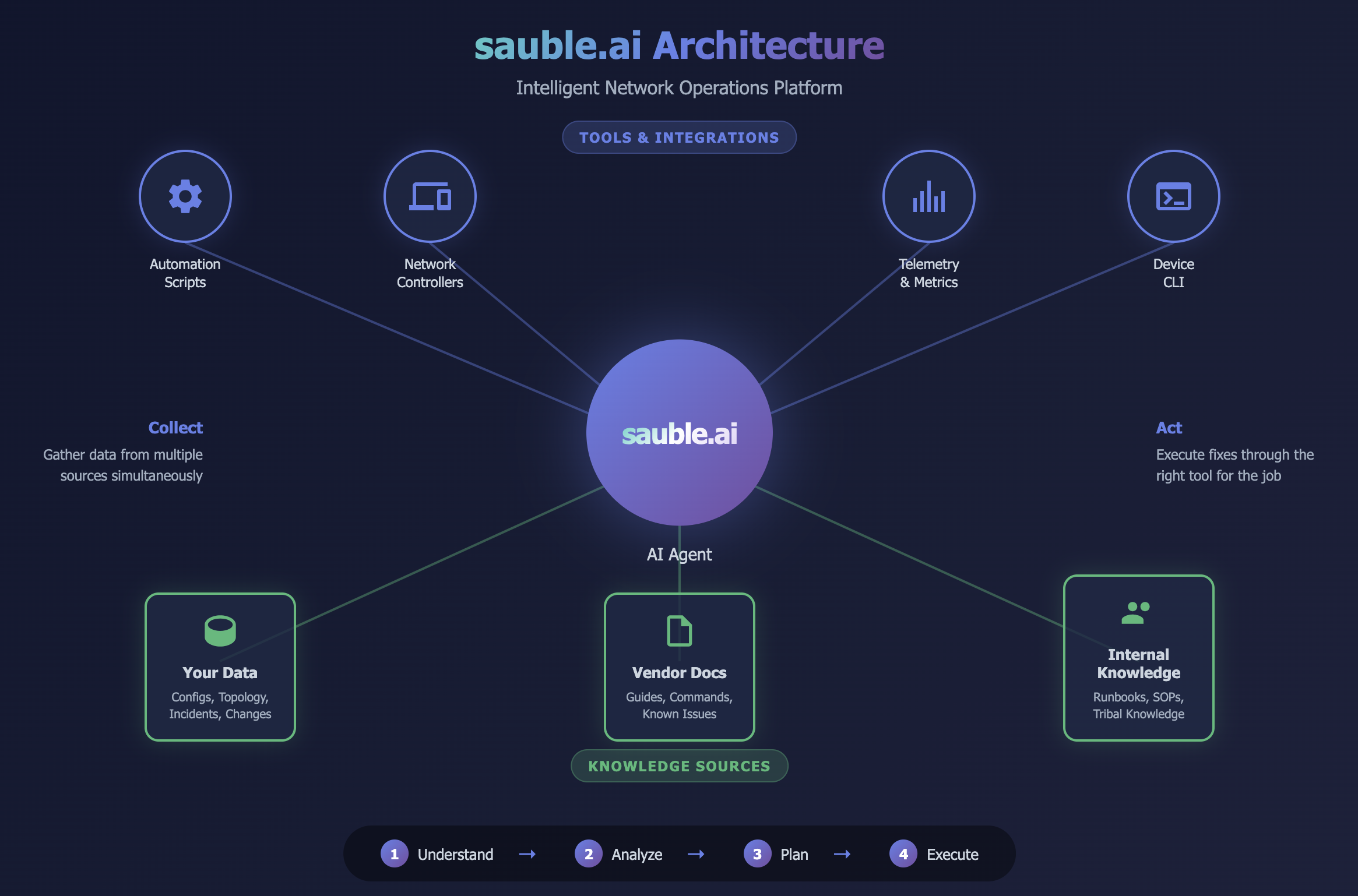
Through one integration, your controller picks up four new feature sets it didn't ship with.
1. Richer Monitoring — Beyond Dashboards
Your controller already emits metrics, events, sessions, and config changes. Sauble's ingestion layer normalizes those streams into a time-aligned, topology-aware model and runs continuous analysis across them.
What your customer sees:
- Cross-signal correlation — a spike in 802.1X failures lined up to a RADIUS shared-secret rotation, on a specific cluster, at a specific site, affecting a specific tenant
- Change-aware monitoring — every alert annotated with the config and firmware changes that immediately preceded it
- Vendor-neutral semantics even when your controller is one of several in a customer's environment (you stay in the picture instead of being relegated to "one of many panes")
The story you can tell your customer changes from "we surface alerts" to "our controller, plus Sauble, tells you what is wrong and for whom — across the network."
2. Evidence-Based Triage, RCA, and Knowledge Tracking
This is the capability customers ask for most and trust least. They've seen "AI RCA" demos that confidently hallucinate.
Sauble's RCA is evidence-based:
- The alert arrives with normalized signals from your controller
- Sauble agents gather evidence — recent config changes, neighbor behavior, historical incidents on the same model/firmware
- Every hypothesis is recorded with the checks that supported or ruled it out
- The conclusion is a structured knowledge artifact, tied to your controller's device class, firmware, and the failure pattern
The next occurrence is recognized automatically. Customer institutional memory accumulates against your platform, which makes your controller stickier — the longer they run it with Sauble, the more proprietary value lives on top of it.
And because every conclusion has an evidence trail, your customers' SREs and auditors get an answer to "why does the AI think that?" — which is the question that kills most "AI in networking" deals at the technical evaluation stage.
3. A Chatbot Over Your Network Data, Not Your Documentation
Most "AI assistants" shipped with networking products are RAG over the admin guide. They tell users what the manual says.
Sauble's assistant is grounded in live data from your controller, through the same integration:
- "Which APs at the Toronto site have been flapping in the last 24 hours?"
- "Show me the clients that failed 802.1X on cluster B after the last config push."
- "What changed between 14:00 and 14:30 yesterday on the SD-WAN edge?"
- "Compare current uplink utilization to the same window last week."
Answers come from current state and resolve to your controller's own IDs and objects. Your customers stop tabbing between dashboards. Your support team stops triaging tickets that are really just "the user couldn't find the screen."
For your product, this is a strategic shift: the controller's data becomes addressable in natural language, by every persona on the customer side — not just the CLI-fluent engineers.
4. Real, Audited Actions on the Controller
Read-only AI is a demo. Actionable AI is a product.
Through the integration, your controller's APIs are exposed back to the platform as safe, parameterized, policy-gated capabilities:
- Disable or re-enable an offending AP, port, or tunnel
- Roll back a recent configuration push
- Steer clients off a saturated band
- Apply a guard-railed policy change to contain a spreading issue
Every action runs through Sauble's approval and audit pipeline:
- Risk-classified (read / soft-change / hard-change)
- Per-tenant policies for what can run autonomously vs. require human approval
- Full audit trail — who (or which agent) invoked it, against which evidence, on which device
You do not have to design this control plane. You do not have to defend it on every RFP. You expose APIs; Sauble wraps them in the safety, policy, and explainability that enterprise buyers require.
The Three Things Your Enterprise Buyers Will Ask About First
The technical wins above are the easy part. Network controller deals — especially in regulated industries, government, and MSP channels — get won or lost on three constraints. Sauble was built with all three as defaults.
Data Governance — Local Models, Local Data
Your customers have already told their auditors that their network telemetry stays in their environment. You cannot ship them an AI feature that breaks that promise.
The Sauble platform runs on the customer's infrastructure, in their region, with models hosted locally. No public AI calls. No "anonymized" exhaust. No shadow data flows. Network telemetry, configurations, and customer-identifying context never leave the customer environment.
For you, this is the difference between a feature that wins regulated deals and a feature your security review forbids customers from enabling.
Cost — A Model That Doesn't Tank Your Margin
Public-cloud-AI economics don't survive contact with always-on network telemetry. If you priced an AI feature as "tokens per device per month," you'd lose money on your largest customers.
Sauble is architected for cost-aware operation at scale:
- Right-sized models per task — small models route, classify, summarize; large models reserved for synthesis and RCA
- Aggressive caching of repeated context so steady-state inventory isn't re-tokenized every query
- Selective retrieval instead of dumping log windows into prompts
- Predictable infrastructure footprint — capacity planned against telemetry volume, not seat counts
The result is an AI feature you can attach to your controller with a viable unit economics story for both you and your customer.
Multi-Tenant by Construction — Built for MSPs and Channels
If MSPs and managed-network providers are part of your go-to-market, multi-tenancy isn't a nice-to-have. It's table stakes.
Sauble's data plane is multi-tenant by construction:
- Isolated tenant data — telemetry, embeddings, and knowledge artifacts never cross tenants
- Per-tenant policies for visibility, suggestion, and action
- Shared improvements, separate data — pattern libraries and detections get better platform-wide without co-mingling customer data
Your MSP partners can deliver AI-driven managed services on top of your controller without operating one trust boundary across all their customers.
What the Integration Actually Looks Like
From your side, integrating with Sauble is concrete and bounded:
- Telemetry ingress — your existing streaming and polled APIs for events, metrics, sessions, and configuration state. Sauble's adapter layer normalizes them. You don't redesign your APIs.
- Action egress — a curated set of your controller's existing operations exposed back to the platform as safe, parameterized capabilities. You decide which actions are in scope and how they're classified.
- Identity and topology mapping — your controller-local IDs (APs, ports, clients, sites, tenants) mapped to Sauble's reasoning graph, so the AI speaks your object model.
What you ship to your customers, on top of your existing roadmap, is a controller that — when paired with Sauble — gives them monitoring intelligence, evidence-based RCA, a natural-language interface, and audited automation. Under your brand. On their infrastructure. Under their data governance.
The Strategic Read
Every controller vendor is going to claim "AI" in the next two cycles. The vendors that win will be the ones whose AI:
- Actually works against current state, not documentation
- Survives the security and data governance review
- Has a cost model that scales with the customer
- Works for MSPs out of the box
- Ships in quarters, not years
Integrating with Sauble is the path to all five — without taking your engineering team off the work that makes your controller unique in the first place.
Building or buying AI for your controller?
If you're a network controller provider evaluating how to add credible, governance-friendly AI to your product, we'd like to be on your short list of conversations.
Contact us to walk through a Sauble integration for your controller — including a technical fit assessment, integration scope, and a path to a co-branded GA.